The ANGARI crew and scientists from Florida International University (FIU) welcomed students and educators from Palm Beach Gardens Community High School onboard R/V ANGARI to spend a day conducting shark research in South Florida.
EXPEDITION DETAILS
October 2, 2026
Palm Beach County, FL
Victoria Goldner
Lorenzo Marro-Ambrosini
Sebastian Ross
William Sample
Emily Spurgeon
All sharks were fished for, caught, studied and released for research purposes under Florida permits held by Florida International University scientists.
The Coastal Ocean Explorers: Sharks program wrapped up the 2026 fall semester with an exciting day of shark research alongside students and educators from Palm Beach Gardens Community High School! Participants joined the ANGARI crew and scientists from Florida International University’s (FIU) College of Arts, Sciences and Education for a hands-on research expedition aboard the R/V ANGARI. Throughout the day, students explored the tools and techniques scientists use to study sharks in Palm Beach County, including deploying drumlines, specialized fishing gear used in shark research, and building and deploying baited remote underwater video systems (BRUVS).
The expedition kicked off with students preparing and deploying a BRUVS in the Lake Worth Lagoon. While the underwater camera collected footage, students put their marine species identification skills to the test by examining video from previous expeditions aboard the R/V ANGARI and exploring footage from the Global FinPrint database. After an hour on the seafloor, the team retrieved the BRUVS and reviewed the day’s research plans before moving on to drumline deployments.
Working in small groups, students took responsibility for assembling, baiting and deploying their own drumlines. Each team practiced the techniques used by researchers in the field, building confidence through hands-on participation. Changing tidal conditions also provided an opportunity to discuss how environmental factors can influence research efforts. This crew now holds the record for the most drumlines deployed on an expedition for this program, ending the day with a total of 33 drumlines deployed! While no sharks were observed on the drumlines or recorded by the cameras, the expedition offered valuable insight into the realities of field research and the importance of collecting data, even when sharks aren’t detected.
Back onboard, FIU scientists helped students explore what researchers can learn from their findings, including why zero observations are still meaningful data. The group discussed how environmental conditions, including recent large storms and changing weather patterns, might influence shark movements and behavior in South Florida waters. From deploying research equipment to interpreting data, students from Palm Beach Gardens Community High School experienced several aspects of what it takes to be a marine scientist. The expedition highlighted the importance of teamwork, curiosity and persistence in scientific research.
This expedition was made possible with funding from the Great Charity Challenge.
CHIEF SCIENTIST
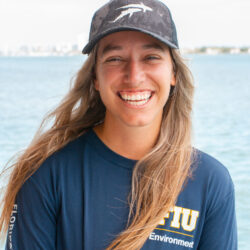
Emily Spurgeon grew up in Minnesota before moving to California to earn her B.S. in Biological Sciences from California Polytechnic State University, San Luis Obispo. She then joined the California State University, Long Beach Shark Lab, where she completed her M.S. studying the movement and behavior of juvenile white sharks in Southern California nursery habitats. Her research combined acoustic telemetry, autonomous underwater vehicles, aerial drones, and real-time tracking to understand the fine-scale behavior of juvenile white sharks and how they interact with their environment. Following her masters, Emily continued at the Shark Lab as a full-time research technician, leading field research, mentoring students, and participating in extensive public outreach and science communication. Emily is now a Ph.D. candidate in the Predator Ecology and Conservation Lab at Florida International University under the advisement of Dr. Yannis Papastamatiou. Her research investigates how environmental conditions shape the movement, behavior, and resource use of large coastal sharks, including juvenile white, bull, and sandbar sharks. By integrating acoustic telemetry, biologging camera tags, and stable isotope analysis, she examines how sharks adjust their behavior across habitats while maintaining their ecological roles. In addition to her doctoral research, Emily continues to work as a research technician with Saving the Blue, contributing to shark research and conservation initiatives throughout The Bahamas and eastern Florida. Emily currently serves as lead scientist for ANGARI’s Palm Beach County based Coastal Ocean Explorers: Sharks program aboard R/V ANGARI.