Inlet Grove Community High School students and educators joined the ANGARI crew and scientists from Florida International University (FIU) for a day of shark research onboard the R/V ANGARI.
EXPEDITION DETAILS
September 23, 2026
Palm Beach County, FL
Emma Aitken
Sami Dhanani
Mia Gabb
Emily Spurgeon
Alondra Vidales
All sharks were fished for, caught, studied and released for research purposes under Florida permits held by Florida International University scientists.
Students and educators from Inlet Grove Community High School stepped aboard R/V ANGARI for the first time for a day of hands-on marine science, getting a firsthand look at what it takes to study sharks and other marine life in the field. Through ANGARI Foundation’s Coastal Ocean Explorers: Sharks program, students worked alongside scientists from Florida International University’s College of Arts, Sciences and Education (FIU) to explore South Florida’s marine ecosystems and experience the process of conducting shark research.
The day began in the Lake Worth Lagoon, where students were introduced to baited remote underwater video systems (BRUVS), a noninvasive tool scientists use to observe marine life in its natural habitat. Students helped prepare and deploy the BRUVS, which uses an underwater camera and bait to capture footage of wildlife passing through the area. While the camera remained on the seafloor, students learned how scientists use this footage to identify species and document the diversity of marine life found in different habitats, as well as put their own species identification skills to the test.
After recovering the BRUVS, R/V ANGARI continued offshore for the day’s shark research activities. Under the guidance of the FIU science team, students learned about drumlines, a specialized type of fishing gear used to safely capture sharks for research. They had the opportunity to prepare and deploy all the drumline gear and observe the careful coordination involved in bringing a shark onboard by the science team, providing a behind-the-scenes look at how scientists conduct fieldwork.
One of the exciting moments of the day was when the team encountered a female great hammerhead (Sphyrna mokarran). Easily recognized by its tall dorsal fin and wide hammer-shaped head, the great hammerhead is an important study subject in shark research. Classified as critically endangered, great hammerheads face significant threats throughout their habitat range, making the opportunity to encounter one during a research expedition particularly meaningful. Students were able to observe the research process firsthand, as the scientists took a tissue sample before quickly and safely releasing the shark.
After a long day of deploying drumlines, the group headed back inshore to review the BRUVS footage and see what the camera had captured. Students reviewed the footage and practiced identifying the species that had visited the camera during the deployment. A very curious juvenile goliath grouper (Epinephelus itajara) was the highlight of the BRUVS footage, coming right up to the camera!
From exploring the Lake Worth Lagoon to encountering a great hammerhead offshore, students from Inlet Grove Community High School experienced the excitement of marine science beyond the classroom. We are grateful to have welcomed Inlet Grove Community High School aboard R/V ANGARI for the first time and to have shared this memorable experience with their students and educators.
CHIEF SCIENTIST
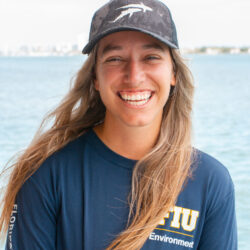
Emily Spurgeon grew up in Minnesota before moving to California to earn her B.S. in Biological Sciences from California Polytechnic State University, San Luis Obispo. She then joined the California State University, Long Beach Shark Lab, where she completed her M.S. studying the movement and behavior of juvenile white sharks in Southern California nursery habitats. Her research combined acoustic telemetry, autonomous underwater vehicles, aerial drones, and real-time tracking to understand the fine-scale behavior of juvenile white sharks and how they interact with their environment. Following her masters, Emily continued at the Shark Lab as a full-time research technician, leading field research, mentoring students, and participating in extensive public outreach and science communication. Emily is now a Ph.D. candidate in the Predator Ecology and Conservation Lab at Florida International University under the advisement of Dr. Yannis Papastamatiou. Her research investigates how environmental conditions shape the movement, behavior, and resource use of large coastal sharks, including juvenile white, bull, and sandbar sharks. By integrating acoustic telemetry, biologging camera tags, and stable isotope analysis, she examines how sharks adjust their behavior across habitats while maintaining their ecological roles. In addition to her doctoral research, Emily continues to work as a research technician with Saving the Blue, contributing to shark research and conservation initiatives throughout The Bahamas and eastern Florida. Emily currently serves as lead scientist for ANGARI’s Palm Beach County based Coastal Ocean Explorers: Sharks program aboard R/V ANGARI.