Thirty Florida educators boarded R/V ANGARI to experience marine science fieldwork firsthand while working with scientists from Florida International University to study sharks in the Lake Worth Lagoon and offshore Palm Beach County.
EXPEDITION DETAILS
July 15 – 16, 2026
Palm Beach County, FL
Daritzel Cinton-Nieves
Victoria Goldner
William Sample
Chase Schaffhauser
Emily Spurgeon
Davon Strickland
All sharks were fished for, caught, studied and released for research purposes under Florida permits held by Florida International University scientists.
Educators from Palm Beach County and beyond stepped aboard R/V ANGARI this summer to experience shark research in action alongside scientists from Florida International University College of Arts, Sciences and Education (FIU). As part of our four-day Summer 2026 Educator Workshop on research and conservation around the Lake Worth Lagoon, participants spent a day experiencing our Coastal Ocean Explorers: Sharks program, learning how scientists study shark populations in and around the Lake Worth Lagoon. The workshop was presented in partnership with Manatee Lagoon and Palm Beach County Department of Environmental Resources Management.
Throughout the expedition, educators gained hands-on experience with two different research methods used to study sharks. The first focused on baited remote underwater video systems (BRUVS), which provide a non-invasive way to study populations of different marine species, as well as better understand species diversity and behavior. After learning how to assemble, deploy and retrieve the BRUVS, participants reviewed the footage they collected alongside videos from previous expeditions to strengthen their marine species identification and data analysis skills. The surveys captured a southern stingray (Hypanus americanus), goliath grouper (Epinephelus itajara) and a variety of other reef fish, giving educators valuable insight into life in the Lake Worth Lagoon.
The second research technique introduced was bottom-set drumlines, a scientific shark fishing method used by researchers to safely capture sharks for brief data collection before release. Educators worked alongside FIU scientists to bait, assemble, deploy and recover drumlines offshore. Once sharks were secured alongside the vessel by the science team, participants assisted researchers with collecting biological data, including measuring each animal, determining its sex and collecting a small tissue sample for analysis. Each shark also received a uniquely numbered National Oceanic and Atmospheric Administration Cooperative Shark Tagging Program (NOAA CSTP) identification tag, which contributes valuable information on shark movements, growth and population dynamics if the animal is captured again. Across both field days, the team studied and released one bull shark (Carcharhinus leucas), two tiger sharks (Galeocerdo cuvier), three nurse sharks (Ginglymostoma cirratum) and five sandbar sharks (Carcharhinus plumbeus).
The expedition provided educators with a firsthand look at the scientific process while connecting them with the scientists advancing shark research in South Florida. By experiencing authentic field research, participants left with new knowledge, practical skills and meaningful stories to bring back to their classrooms to hopefully inspire the next generation of ocean stewards.
The Coastal Ocean Explorers: Sharks expeditions and programming within the Summer 2026 Educator Workshop was made possible with funding from the Palm Beach International Boat Show Gives Back grant program to ANGARI Foundation.
CHIEF SCIENTIST
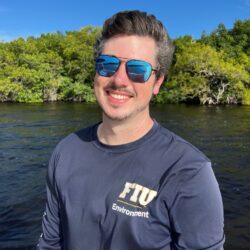
Will Sample is a Ph.D. candidate in the Marine Community and Behavioral Ecology Lab at Florida International University. His current research uses both long-term historical datasets and newer methods, such as high-resolution accelerometry, to study the movement and behavioral ecology of juvenile bull sharks. He specifically focuses on the way these sharks may be transporting nutrients across habitat boundaries, how they may be optimizing their movements to save energy and what the long-term implications of different behaviors they specialize in may be. Will’s research in the Florida Everglades studying the ways sharks move through this crucial ecosystem is important for conservation and informing habitat restoration and management efforts. Will earned a B.S. in Liberal Arts and Sciences from Florida Atlantic University in 2018 and has lived all throughout Florida for most of his life, from Jacksonville to Jupiter to the Keys. He is passionate about community outreach and education, particularly regarding Florida’s natural habitats, and currently serves as lead scientist for ANGARI’s Palm Beach County based Coastal Ocean Explorers: Sharks program aboard R/V ANGARI.