Students and educators from Independence Middle School joined scientists from Florida International University (FIU) for an exciting day of shark research onboard the R/V ANGARI.
EXPEDITION DETAILS
September 14, 2026
Palm Beach County, FL
Gina Badlowski
Daritzel Cintron Nieves
Sophia Hemsi
Shane Molander
Emily Spurgeon
All sharks were fished for, caught, studied and released for research purposes under Florida permits held by Florida International University scientists.
The ANGARI crew welcomed students and educators from Independence Middle School onboard R/V ANGARI for a day of hands-on marine science as part of the Coastal Ocean Explorers: Sharks program! As members of SciQuest Academy, an inquiry-based science program at Independence Middle School, students had the opportunity to work alongside scientists from Florida International University’s College of Arts, Sciences and Education (FIU) to conduct shark research in South Florida.
The day began in the Lake Worth Lagoon, where students worked with baited underwater remote video systems (BRUVS), a noninvasive research tool used by scientists to study marine life. Students helped prepare and deploy the BRUVS, which uses an underwater camera and bait to attract and record marine species in their natural environment. While the camera was collecting footage on the seafloor, students put their species identification skills to work, learning how scientists distinguish between the many species that call South Florida’s coastal waters home.
With the BRUVS back onboard, the team headed offshore to continue their day of fieldwork. Students worked alongside the FIU science team to prepare and deploy drumlines, a specialized type of fishing gear used to safely capture sharks for scientific research. Throughout the day, students experienced the research process firsthand, from hauling lines and safely bringing gear back onboard to collecting data from a few different sharks.
The team deployed a total of 16 drumlines throughout the day and captured and released two Atlantic nurse sharks (Ginglymostoma cirratum) and one lemon shark (Negaprion brevirostris)! Once each shark was safely secured by the science team, students observed and worked alongside the scientists as they performed efficient shark workups. The workups included taking several measurements, collecting tissue samples and tagging each shark with a National Oceanic and Atmospheric Administration Cooperative Shark Tagging Program (NOAA CSTP) identification tag. Finally, the sex of each shark was determined by feeling for the presence of claspers, which are modified fin appendages found on the underside of male sharks. All three of these sharks were male, with the lemon shark being the largest shark captured and measuring a total of 7.4ft long!
At the end of the day, students and educators headed inshore and reviewed their BRUVS footage which captured a variety of different fish species! Some of the species captured on camera included common snook (Centropomus undecimalis), mutton snapper (Lutjanus analis) and Atlantic porkfish (Anisotremus virginicus). We loved welcoming this group back onboard and watching them continue to grow their curiosity and confidence as young scientists!
CHIEF SCIENTIST
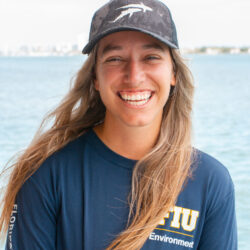
Emily Spurgeon grew up in Minnesota before moving to California to earn her B.S. in Biological Sciences from California Polytechnic State University, San Luis Obispo. She then joined the California State University, Long Beach Shark Lab, where she completed her M.S. studying the movement and behavior of juvenile white sharks in Southern California nursery habitats. Her research combined acoustic telemetry, autonomous underwater vehicles, aerial drones, and real-time tracking to understand the fine-scale behavior of juvenile white sharks and how they interact with their environment. Following her masters, Emily continued at the Shark Lab as a full-time research technician, leading field research, mentoring students, and participating in extensive public outreach and science communication. Emily is now a Ph.D. candidate in the Predator Ecology and Conservation Lab at Florida International University under the advisement of Dr. Yannis Papastamatiou. Her research investigates how environmental conditions shape the movement, behavior, and resource use of large coastal sharks, including juvenile white, bull, and sandbar sharks. By integrating acoustic telemetry, biologging camera tags, and stable isotope analysis, she examines how sharks adjust their behavior across habitats while maintaining their ecological roles. In addition to her doctoral research, Emily continues to work as a research technician with Saving the Blue, contributing to shark research and conservation initiatives throughout The Bahamas and eastern Florida. Emily currently serves as lead scientist for ANGARI’s Palm Beach County based Coastal Ocean Explorers: Sharks program aboard R/V ANGARI.